
Short answer
Minimum bend radius is the geometric limit specified for a hose under the relevant service condition. The static/dynamic distinction in the catalog and the measurement reference of the radius must be checked; the fact that a hose bends easily by hand does not define the technical limit.
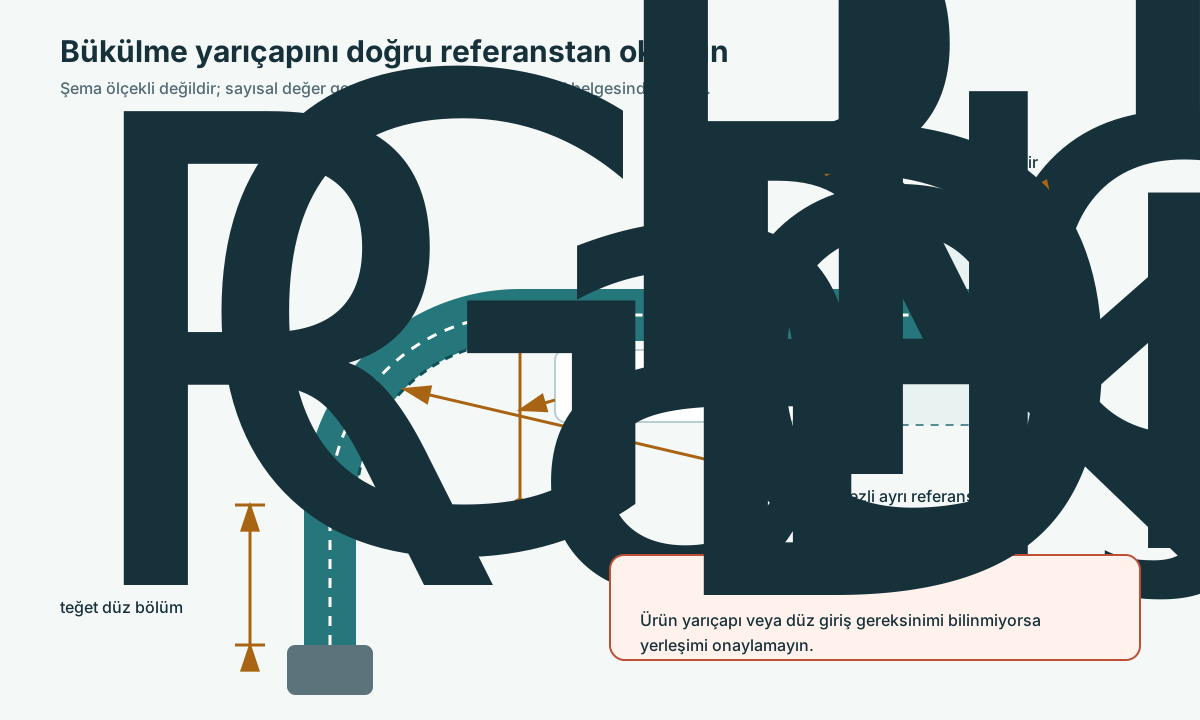
The same number can belong to a different reference
In the terminology section of the Swagelok catalog, the minimum bend radius is defined separately for static and dynamic use. The radius may be given relative to the centerline or the inside of the bend. Therefore, two catalog values should not be compared directly without recording the measurement reference.
Source: S024
Recommended fields for a bend record
| Field | Record |
|---|---|
| Product | Manufacturer, series and nominal/actual size |
| Condition | Static or dynamic use |
| Reference | Centerline, inside of bend, or unclear in the source |
| Value | Unit and source table row |
| Routing | Route, supports, motion envelope and end orientations |
Original editorial recommendation; not a clause of a standard.
Radius alone is not enough
First read the radius reference in the catalog: is it the centerline or the inside of the bend? On the assembly drawing, use the same reference to show the distance from the center of curvature to the relevant curve. Separately mark the straight section that the product requires at the fitting end; do not include this section in the bend arc. In a moving application, check both end positions, not just the middle position. Do not compare static and dynamic values, different measurement references or different product codes as a single number.
Source: S031
When checking the routing drawing
- Does the value belong to the correct product code and size?
- Is the static/dynamic distinction clear in the source?
- Is the centerline or inside-of-bend reference of the radius known?
- Has the required straight section at the base of the fitting been verified from the product documentation?
- Does torsion, tension or crushing occur at the extreme positions of the motion envelope?
- Do the supports and guards create a new point of abrasion or strain?
Frequently asked questions
Can a more flexible hose be bent tighter?
We do not decide based on perceived flexibility alone; we ask for the value for the relevant product and service condition.
Original editorial recommendation; not a clause of a standard.
Can I use the static value for a moving machine?
No such match is made without explicitly checking the static/dynamic distinction.
Source: S024
Source coverage
-
S024
Hose and Flexible Tubing, MS-01-180 Swagelok · accessed 2026-10-19 PDF page 4 / printed page 253: Nomenclature text definitions
-
S031
Hydraulics in Action: Maximizing Hose Lifetime Continental · accessed 2026-10-19 Optimizing Hose Routing for Longevity