
Short answer
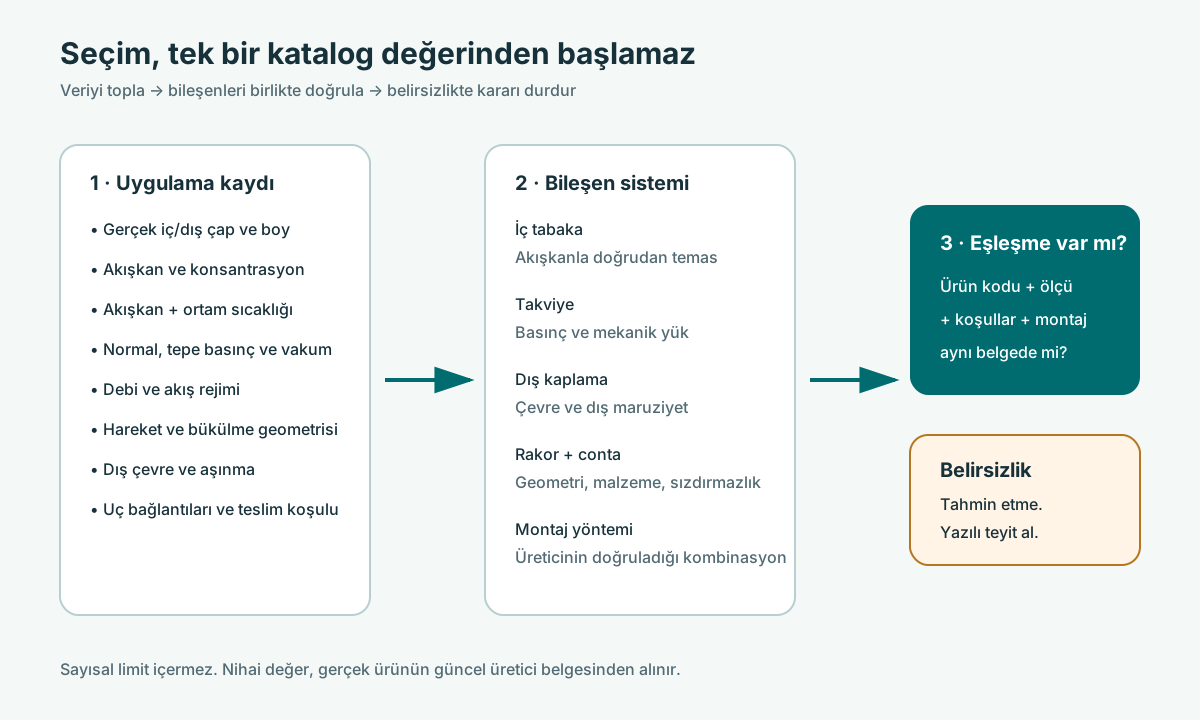
Hose selection does not start with diameter and pressure alone. The fluid, temperature, application, dimensions, pressure/vacuum and end connections must be defined together. STAMPED is a reminder used to gather this information; on its own it does not constitute product approval.
Source: S021
Define the application before selecting
First describe the job the hose will do: is it transferring fluid from one tank to another, working on a moving machine, or installed in a suction line? Within STAMPED, this information is assessed together with pressure, temperature and connections. The delivery requirement is part of the commercial plan; it does not replace technical suitability.
Source: S021
Suggested request form
| Field | Information to record |
|---|---|
| Fluid | Full name, mixture, concentration and, if available, the safety data sheet |
| Operating condition | Normal value, peak value, vacuum and the measurement source of the value |
| Temperature | Fluid and ambient; continuous, transient and cleaning conditions |
| Geometry | Inside diameter, overall length, movement, routing and space constraints |
| Ends | End A/B, mating part, sealing type and orientation |
| Documents | Expected conformity, inspection and traceability records |
Original editorial recommendation; not a clause of a standard.
Do not fill missing information with guesses
In the workflow we recommend, unknown fields stay empty and await technical confirmation. "The existing hose was like this" is not recorded in place of application data; it becomes a separate observation. A photo of the old label, machine documentation and user statements are kept as separate sources.
Original editorial recommendation; not a clause of a standard.
Before closing the selection decision
- Are normal, peak and transient pressures and vacuum in the same record but in separate fields?
- Are continuous/transient values of fluid and ambient temperature kept separate?
- Has the fluid/environment compatibility of the inner tube, outer cover, seal and metal parts been verified?
- Have the actual inside diameter, flow rate, pressure drop and installation constraints been assessed together?
- Have bending, twisting, vibration, tension, abrasion and hot-surface effects been recorded?
- Has the hose-fitting-assembly method been verified within the same current manufacturer system?
Frequently asked questions
Is a photo of the old hose enough?
We use the photo as input for identification; we request the missing service data separately.
Original editorial recommendation; not a clause of a standard.
What information should I prepare first?
Start with the fluid, temperature, pressure/vacuum, dimensions and end connections.
Source: S021
Source coverage
-
S017
Parker Safety Guide, Publication 4400-B.1 Parker Hannifin · accessed 2026-10-20 PDF page 2; 2.2 Pressure, 2.3 Suction, 2.4 Temperature, 2.5 Fluid Compatibility, 2.6 Permeation, 2.7 Size, 2.8 Routing, 2.9 Environment and 2.10 Mechanical Loads
-
S021
Selecting a hose assembly? Remember STAMPED Swagelok Bangalore · accessed 2026-10-19 Size through Delivery