
Short answer
A chemical compatibility table is a pre-screening source; on its own it is not approval for use of a finished hose assembly. The fluid's concentration, temperature, contact time and the seal/fitting materials along with the hose must be taken into account.
Source: S020
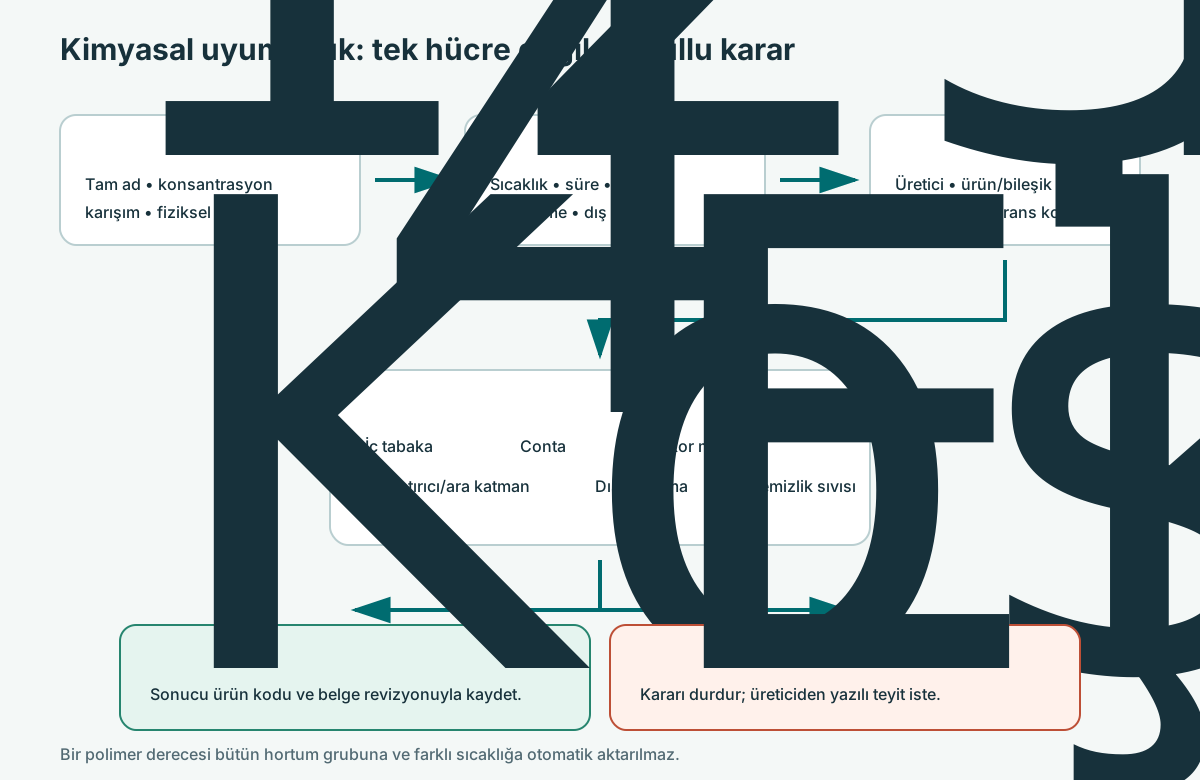
Do not separate the rating from its condition
Unless otherwise stated, Gates ties its ratings to specific concentration and temperature conditions. It also reminds that permeation must be considered even without visible material degradation. For this reason, the statement "the table is green" is not a complete technical justification.
Source: S020
Mandatory context in a compatibility record
| Field | Expected information |
|---|---|
| Fluid | Name, CAS number if needed, mixture and concentration basis |
| Contact | Continuous/intermittent; cleaning fluid and dwell condition |
| Temperature | Reference temperature and application temperature |
| Material | Product/compound code where possible, not a general polymer name |
| Evidence | Manufacturer table, footnote and application approval |
| Result | Source rating; distinction between conditional/unsuitable/unknown |
Original editorial recommendation; not a clause of a standard.
Limits on combining tables from different manufacturers
The letter and number ratings of different manufacturers are not automatically converted to the same meaning. The source's own definition, footnotes and conditions of use are preserved. The explanations in the Gates table are the source basis of this guide; carrying the same codes over to another manufacturer's table is not recommended.
Source: S020
Before using a table cell
- Do the chemical's full name, form, concentration and mixture components match?
- Does the table's reference temperature cover the continuous and peak temperatures of the application?
- Is the rating for continuous or intermittent contact, or does it mean no data?
- Does the cell evaluate the hose product, a general polymer, the coupling or the adapter?
- Have the seal, fitting, cover, cleaning fluid and external environment each been checked separately?
- For services such as gas/fuel, have permeation and ventilation risks been examined separately?
- For a substance that is not listed or whose condition does not match, has written confirmation been requested from the manufacturer?
Source: S020
Frequently asked questions
Does an empty cell in the table mean suitable?
No; an empty or unknown result is not a suitability approval.
Original editorial recommendation; not a clause of a standard.
Is it enough to look only at the hose inner tube?
The Gates guide also contains separate warnings for connection materials and permeation.
Source: S020
Source coverage
-
S020
Chemical Resistance Chart Gates · accessed 2026-10-19 PDF page 2 / printed page 1; introductory paragraphs and notesPDF page 4 / table page 3; rating legend and notes