
Short answer
A camlock is a quick, tool-free coupling in which a male adapter and a female coupler are joined by closing the arms. When choosing, temperature, material, maximum working pressure and manufacturing quality are assessed together; the type letter (A, B, C, D, E, F, DC, DP) defines the form of the coupling.
Source: S114
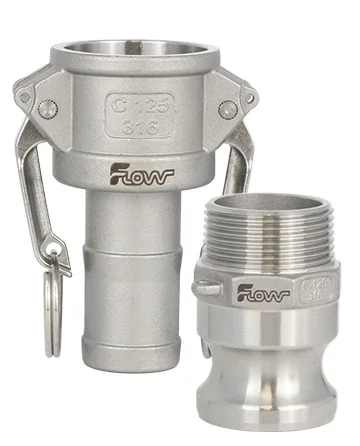
What is a camlock?
Camlock couplings make it easy to transfer fluids between two hoses or pipes; they are also called cam and groove couplings. They are very simple to connect and disconnect and need no tools. They can replace some conventional hose and pipe connections that take time to fit. Their versatility and relatively low cost make them one of the most widely used couplings in the world.
Source: S114
Where is it used?
Camlocks are used in almost every industry, such as manufacturing, agriculture, oil, gas, chemicals, pharmaceuticals and military applications. Because they do not use a threaded connection, there are no problems with threads getting dirty or damaged, which makes them ideal for dirty environments. They are also very well suited to applications that need frequent hose changes, such as tanker trucks carrying oil and industrial chemicals.
Source: S114
How does a camlock work?
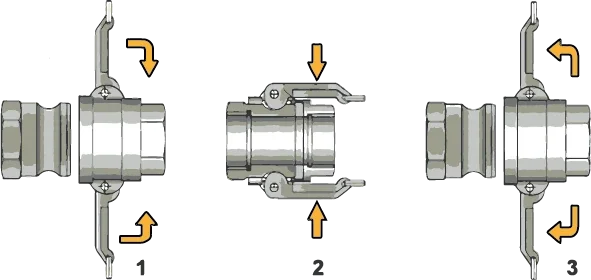
- A camlock coupling consists of two parts: a male adapter and a female coupler.
- To connect, open the arms of the female coupler outwards and insert a male adapter of the right size into the coupler (1).
- Hold the two parts firmly together by closing both arms at the same time (2). Closing the arms together keeps the grooved adapter pressed evenly against the gasket, so the fluid is transferred safely without leaking.
- Always release the pressure in the hose line before disconnecting; then carry out the steps in reverse order (3).
Source: S114
How is the size measured?
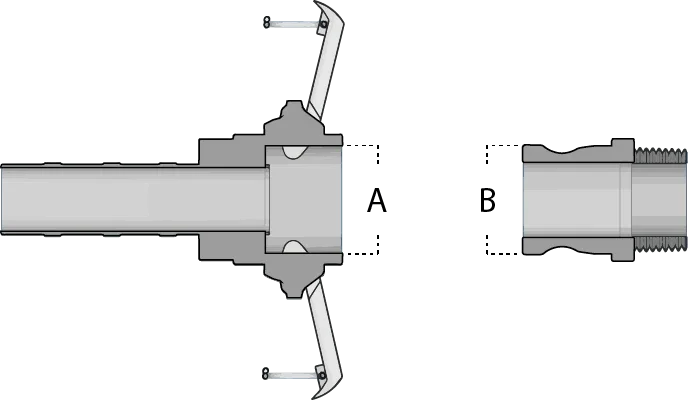
The measuring point of a camlock coupling depends on its type: female camlocks are measured inside (A), male camlocks outside (B). Take the measurement at these points for correct assembly and a proper match.
Source: S114
Selection criterion: temperature
The temperature limits of the coupling are determined by the material chosen. For example, the maximum temperature polypropylene (PP) can withstand is 70 °C (158 °F), and pressure ratings must be reduced by 40% at this temperature. With stainless steel, the operating temperature ranges from -101 °C to +260 °C (-150 °F to +500 °F). Besides the material of the camlock, the minimum and maximum operating temperatures also depend on the working pressure, the fluid carried and external factors such as the weather; you therefore need to know the details of the application and its operating temperatures.
Source: S114
Selection criterion: material
| Material | Properties | Advantages | Disadvantages | Applications |
|---|---|---|---|---|
| Stainless steel | Corrosion resistant; compatible with various media; long service life | Clean inner surface; thermal resistance; high strength | High cost | Acids, alkalis and highly corrosive environments |
| PP (polypropylene) | Low density; resistant to acids, alkalis and organic solutions; chemically stable; resistant to ageing | Leak-tight; lightweight; low price; easy to use | Low strength; deforms easily | Acidic and alkaline media; transfer of liquids in the chemical industry; agricultural irrigation |
| Brass | Electrical conductivity; resistant to seawater | Easy assembly | High cost | Salt water and media other than acids and alkalis; marine applications; deep well operations |
| Aluminium alloy | Low density, high strength; good formability; electrical and thermal conductivity | Cost-effective | Weaker corrosion resistance than stainless steel; susceptible to mould and oxidation | Fresh water mixtures |
Source: S114
Selection criterion: maximum working pressure (at room temperature)
| Nominal size | Aluminium | Stainless steel 316 | Brass | PP |
|---|---|---|---|---|
| 1/2" | 10.34 bar (150 psi) | 10.34 bar (150 psi) | 17.23 bar (250 psi) | 5.17 bar (75 psi) |
| 3/4" | 17.23 bar (250 psi) | 17.23 bar (250 psi) | 17.23 bar (250 psi) | 6.89 bar (100 psi) |
| 1" | 17.23 bar (250 psi) | 17.23 bar (250 psi) | 17.23 bar (250 psi) | 6.89 bar (100 psi) |
| 1 1/4" | 17.23 bar (250 psi) | 17.23 bar (250 psi) | 17.23 bar (250 psi) | 6.89 bar (100 psi) |
| 1 1/2" | 17.23 bar (250 psi) | 17.23 bar (250 psi) | 17.23 bar (250 psi) | 6.89 bar (100 psi) |
| 2" | 17.23 bar (250 psi) | 17.23 bar (250 psi) | 17.23 bar (250 psi) | 6.89 bar (100 psi) |
| 2 1/2" | 10.34 bar (150 psi) | 15.51 bar (225 psi) | 10.34 bar (150 psi) | – |
| 3" | 8.61 bar (125 psi) | 13.78 bar (200 psi) | 8.61 bar (125 psi) | 3.44 bar (50 psi) |
| 4" | 6.89 bar (100 psi) | 6.89 bar (100 psi) | 6.89 bar (100 psi) | 3.44 bar (50 psi) |
| 5" – 6" | 5.17 bar (75 psi) | 5.17 bar (75 psi) | 5.17 bar (75 psi) | – |
| 8" | 10.34 bar (150 psi) | – | 3.44 bar (50 psi) | – |
Source: S114
Selection criterion: manufacturing quality
It is important to know the supplier of a camlock coupling. Even when they are made to the same standard, small differences in manufacturing methods can mean that one manufacturer's part does not fit another's; this is a common problem with cheap camlocks. Make sure the couplings come from a high-quality, reputable manufacturer; ideally, the adapter and coupler sides come from the same manufacturer.
Source: S114
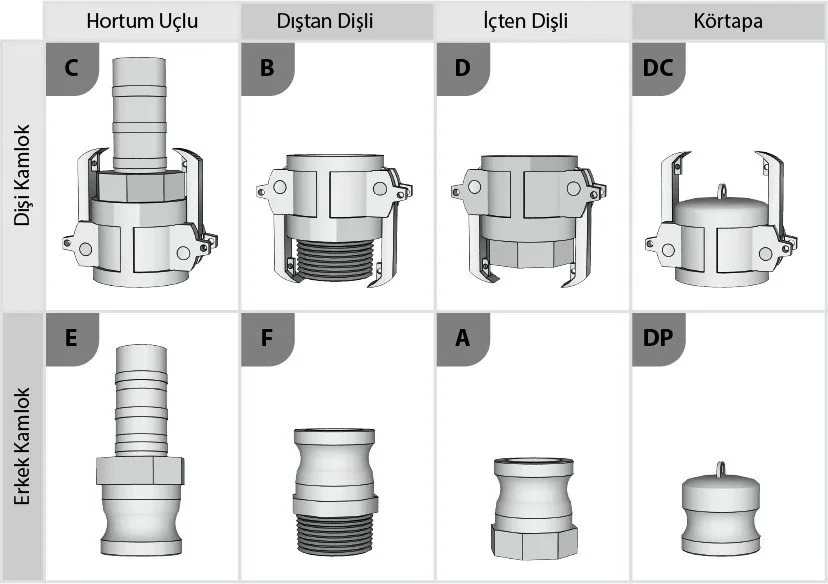
Camlock coupling types
| Type | Description |
|---|---|
| A | Male camlock with internal thread |
| B | Female camlock with external thread |
| C | Female camlock with hose shank |
| D | Female camlock with internal thread |
| E | Male camlock with hose shank |
| F | Male camlock with external thread |
| DC | Female camlock blind cap |
| DP | Male camlock blind plug |
Source: S114
Source coverage
-
S114
Kamloklar (Kamlok Rehberi) Flow Hose · accessed 2026-11-06 Camlock guide; How do camlocks work?Camlock guideHow do camlocks work?Selection criteria for camlock couplingsSelection criteria: temperatureSelection criteria: material tableSelection criteria: maximum working pressure tableSelection criteria: camlock manufacturing qualityCamlock coupling types